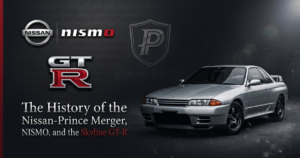

In the 1990s, the R32 Skyline GT-R carved its name into history by achieving an unbroken streak of 29 consecutive victories in the All Japan Touring Car Championship (JTC).
Behind that overwhelming success stood an engineer who accepted the torch while facing unprecedented pressure: following a legend. That man was Kozo Watanabe, the Chief Vehicle Engineer responsible for the R33 and the iconic R34 Skyline GT-R.
Shinichiro Sakurai poured in the “soul of driving,” and Norihiro Ito broke down the “wall between Oppama and Omori” to resurrect the GT-R. Inheriting that legacy, Watanabe partnered with NISMO (Nissan Motorsports International)—which had reached its 10th anniversary—to elevate the Skyline GT-R into a global icon.
1. Born in Prince, Raised in Oppama: The Key Figure Embodying the Merger
Kozo Watanabe’s career was a living reflection of the history between Nissan and Prince.
In 1967, right after the merger between Nissan and Prince, he joined the former Prince headquarters at Ogikubo (Vehicle Engineering Department No. 1). One of his department heads was Shinichiro Sakurai, and serving under him as a senior engineer was Norihiro Ito, who would later become the Chief Engineer of the R32. Watanabe’s career started directly under the two giants of the Skyline legacy.
When the young Watanabe directly requested, “I want to design race cars,” Sakurai advised him, “Learn about production cars first.” Yet, Sakurai assigned him to work on the suspension design of the Hakosuka GT-R and the development of the R381/R382 prototype racing cars, steadily instilling the mindset of a true craftsman.
However, as emissions regulations and safety standards tightened, the R38 racing program was halted, bringing a major turning point in Watanabe’s career.
In 1970, Watanabe was transferred from Ogikubo to Tsurumi—Nissan’s core technical base—where he worked on the Experimental Safety Vehicle (ESV) department, focusing on crash safety research. After returning to Ogikubo to work on the suspension design and facelift for the “Kenmeri” Skyline, he moved to corporate engineering headquarters. There, he contributed to overall vehicle strategies, including foundational concepts for the 6th-generation (R30) and 7th-generation (R31) Skylines.
In 1987, at the Tochigi Proving Ground, he was appointed head of vehicle testing for the 8th-generation “R32” Skyline. For the basic research on ATTESA E-TS—the electronic all-wheel-drive system that formed the core of the R32 GT-R—he repeatedly conducted test runs using modified R31s and Laurels, refining the system to perfection.
Inheriting the bloodline of former Prince (Ogikubo) while grinding through testing at Nissan’s Tsurumi and Tochigi facilities, Watanabe understood the philosophies and technologies of both factions better than anyone. It was precisely because of this unique background that he was chosen to lead the next-generation Skyline.
2. Struggles of the R33: Overcoming the Giant R32 and the “Minus 21-Second Romance”
In 1992, Kozo Watanabe was appointed Chief Vehicle Engineer for the Skyline. However, he was immediately greeted by corporate cost-cutting measures following the collapse of the Japanese asset bubble, alongside intense skepticism from both inside and outside the company.
With the economic bubble burst, management ordered him to share a platform (wheelbase) with the Laurel to cut costs. However, extending the wheelbase brought internal turmoil: would it make the Skyline “too large” and stray from its sporty roots?
Furthermore, automotive journalists and the public voiced doubt: “The R32 is like Chiyonofuji in sumo wrestling—a flawless grand champion. Why not just keep making the R32 as it is?”
While the zero-base introduction of the R32 had a massive impact, it also carried drawbacks: complaints from sales dealerships about lack of 4-door cabin space, as well as clutch and brake durability issues.
Watanabe burnt his bridges, declaring, “The latest GT-R must always be the best GT-R.” To resolve the R32’s weaknesses while securing formal corporate approval for the R33 GT-R, he created a dedicated Product Lead position for the GT-R. He appointed Masatoshi Yoshikawa—an engineer with whom he had previously clashed over a promotional Nürburgring video shoot.
“A longer wheelbase hurts agility, but it provides a huge advantage in braking stability and high-speed balance.”
To surpass his greatest rival—the R32 he had personally helped create—Watanabe tirelessly refined the vehicle: re-tuning the RB26DETT engine, increasing lateral suspension rigidity (using wishbone arm architecture for front upper arm ), and advancing the Active LSD and Super-HICAS systems.
If the R32 was a sudden leap from 60 to 80 points, the R33 was often viewed as “only a 20-point improvement,” despite its thorough refinement. To prove its undeniable evolution, Watanabe staked everything on a lap time attack at the Nürburgring.
During early testing at Nürburgring, when he reported a calculated target lap time of 8:02 to top executives, he was yelled at: “Are you stupid?! Do you understand the psychological difference between 40,200 yen and 39,800 yen?!” Breaking the 8-minute barrier (sub-8 minutes) became a non-negotiable mandate.
Under immense pressure, the team clocked a time of 7 minutes 59 seconds. Shaving 21 seconds off the R32’s record gave birth to the legendary advertising tagline: “A Romance of Minus 21 Seconds.” Watanabe recalled feeling immensely relieved, thinking, “Now I can finally go back to Japan.”
Yet the trials continued. At its motor show unveiling, the design was harshly criticized, forcing an emergency redesign incorporating ideas from younger designers to create a more aggressive front fascia.
Furthermore, immediately after its debut, the R33 suffered a devastating defeat to the older R32 GT-R at a Super Taikyu race at Mine Circuit. A furious dealership president yelled at him, “Are you telling me to sell the old car?!” The experience left Watanabe so traumatized that looking at Mine’s guest house gave him stomach aches.
Master test driver Hiroyoshi Kato, known for his uncompromising standards, called Watanabe at home right after work almost daily, pleading, “Increase the budget or give me more test time!” Watanabe could only reply, “I’m not a magician, I have no money or time to give. You’re the only one on the ground I can rely on.” Under stomach-churning pressure, the R33 GT-R was pushed toward completion.
Overwhelmed by stress, Watanabe began overeating sweets and gained weight, leading his doctor to warn him of potential liver dysfunction and put him on a strict sugar ban. Cutting out sweets for three months caused him to lose 7 kilograms so quickly that colleagues worried he was terminally ill. Fighting through these absurd pressures, Watanabe successfully brought the R33 GT-R into the world.
3. Passion for the R34 and Unification with NISMO
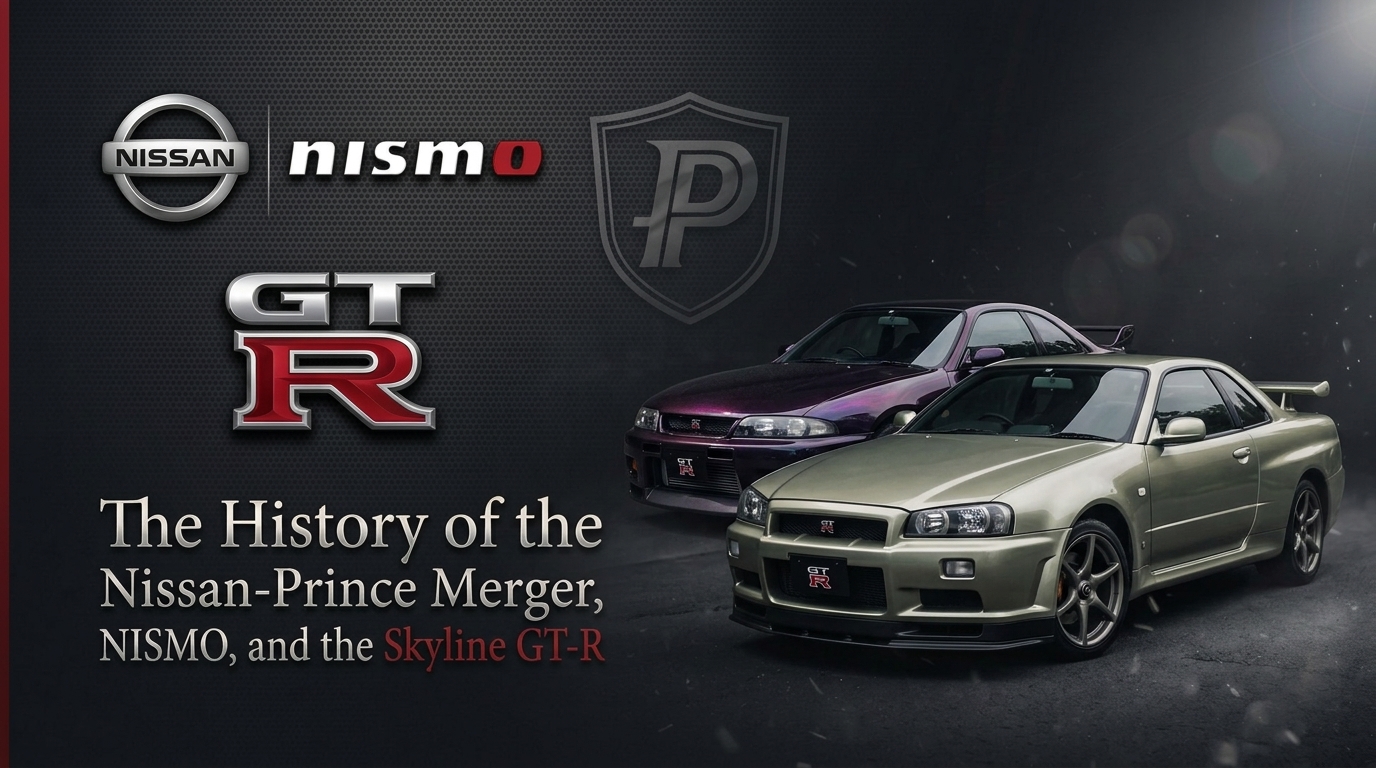
Carrying the lessons and struggles of the R33, Watanabe introduced the 10th-generation R34 Skyline GT-R (1999) as the pinnacle of the second-generation GT-R era.
The objective was not merely reducing lap times, but regaining the uncompromising essence of raw performance—a challenge to express “ultimate driving pleasure” through physical and numerical precision.
The body dimensions were condensed once more, body rigidity was dramatically increased, and aerodynamic design fully leveraged NISMO’s track-proven expertise from JGTC racing, featuring an Advanced Aero System with a full underbody diffuser. The historical era of Oppama and Omori hiding data from each other was completely gone; a supreme machine was born, perfectly aligning Nissan’s engineering with NISMO’s racing spirit.
During the development of the R34 GT-R, Watanabe and his team explored a secret, radical idea that ultimately went unfinished: equipping the GT-R with a Toroidal CVT for a 2-pedal automatic transmission.
Utilizing a Toroidal CVT developed by Nissan’s Central Research Laboratory, they created an electronically controlled system capable of simulated manual shifting. Inspired by the paddle-shift systems gaining popularity in Ferraris at the time, Watanabe pushed the team, saying, “Then make it an 8-speed!” and conducted extensive prototype testing.
The test results were outstanding, earning praise from external evaluators who called it “a savior for Nissan Motor Company.” However, due to technical challenges and commercial timing, the Toroidal CVT’s production debut was passed to models like the Y34 Cedric/Gloria and V35 Skyline.
Later, Watanabe humorously reflected on this phantom CVT concept:
“The most fortunate part was that while the GT-R officially had 280 horsepower, owners would tune them up to 1,000 horsepower after reading tuning magazines. If we had equipped it with the Toroidal CVT, it couldn’t have handled that torque, and we would have faced massive customer complaints (laughs). So looking back, maybe it was a good thing it wasn’t adopted—call it my sore loser excuse!”
Because Watanabe pushed the core fundamentals of the production R34 GT-R to the limit without compromise, it served as the ultimate foundation for legendary complete cars created by NISMO years later, including the iconic Z-tune.
Completely overcoming past internal rivalries, the R34 GT-R was born out of a pure pursuit of driving enjoyment. It stands today as the crowning achievement of the second-generation GT-R, continuing to captivate enthusiasts around the globe.
4. Conclusion: The Leader Who Completed the Second-Generation GT-R
Shinichiro Sakurai instilled the “will,” Norihiro Ito revived the GT-R through “passion,” and Kozo Watanabe brought the second-generation GT-R (R32 / R33 / R34) to its ultimate completion through “meticulous experimental engineering and unification with NISMO.”
Having walked the floors of Ogikubo, Tsurumi, and Tochigi, Watanabe personally embodied the convergence of Oppama and Omori. Under his leadership, the history of internal conflict bore fruit in a singular mission: “Building the absolute best car as One Nissan.”
Overcoming the bitter struggles of the R33 and regaining the pure essence of driving with the R34, Watanabe’s legacy lives on. The uncompromising performance technology and motorsport passion passed down by these engineers continue to flow seamlessly into today’s R35 GT-R and the modern NISMO lineup.