


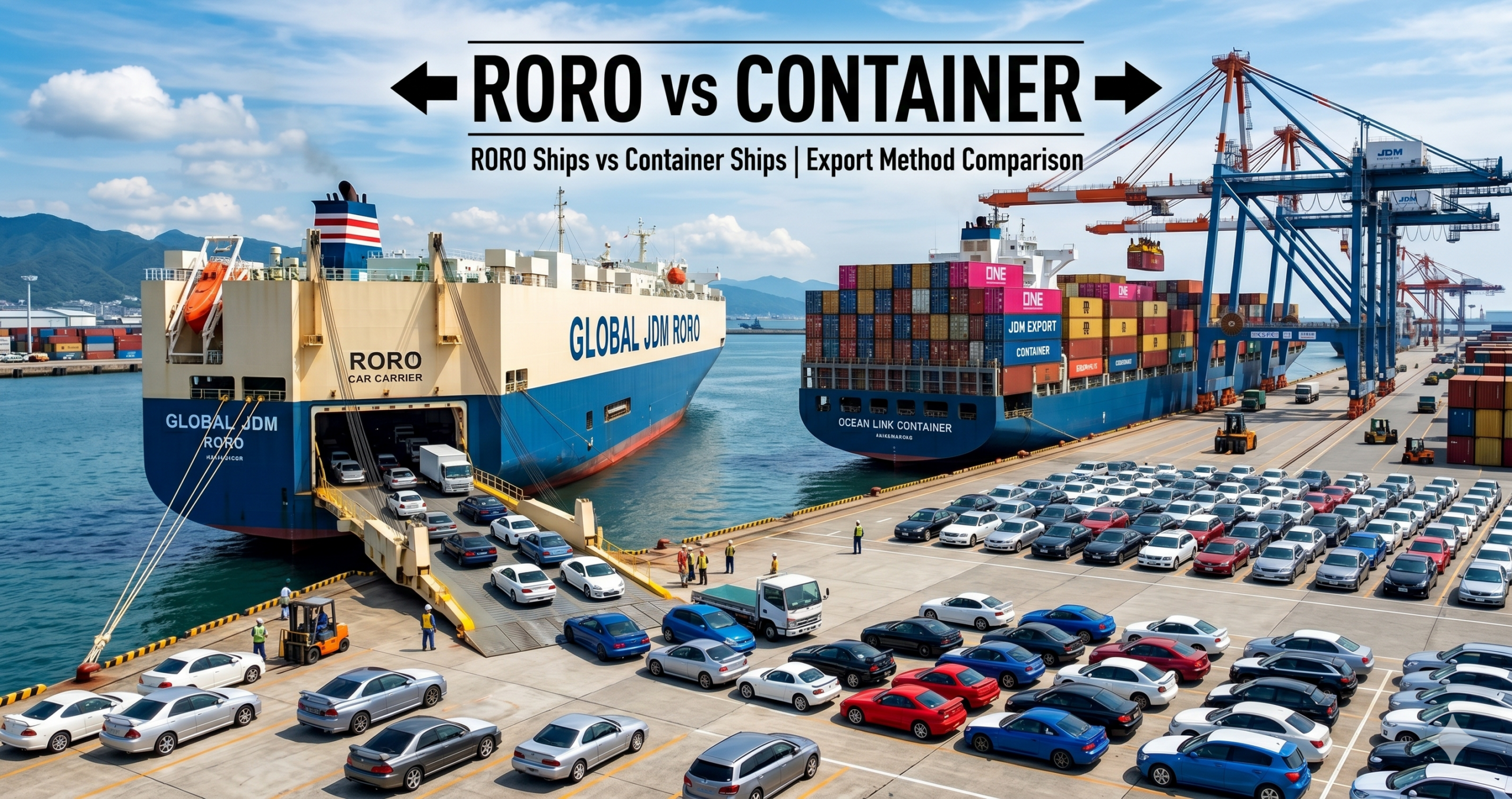
When importing a used car from Japan, choosing the right shipping method is one of the most critical decisions affecting your budget, vehicle safety, and logistics. There are two primary methods: RORO (Roll-on/Roll-off) and Container Shipping.
| Quick Comparison Overview | ||
| Feature | RORO (Roll-on/Roll-off) | Container Shipping (20FT / 40FT) |
| Cost | Economical (Charged per vehicle) | Higher for single cars (Charged per container) |
| Security & Safety | Moderate (Exposed to elements/handling) | Excellent (Locked inside a steel box) |
| Vehicle Condition | Must be fully operational (drivable) | Accepts non-runners, accident cars, and classics |
| Spare Parts / Cargo | Strictly Prohibited inside the car | Allowed (Can pack parts alongside the vehicle) |
| Destination Coverage | Major automotive ports only | Almost any major commercial port worldwide |
- 1) RORO (Roll-on/Roll-off) Shipping
-
The Most Cost-Effective Method for Standard Vehicles
RORO ships are massive, specialized vessels designed exclusively for transporting wheeled cargo. Think of a RORO ship as a giant, multi-level floating parking garage. Vehicles are driven onto the ship at the Japanese port and driven off at the destination port.
The Pros:
Unbeatable Cost: This is the most economical way to ship a single vehicle. Freight charges are calculated based on the vehicle’s dimensions ($M3$ volume), making it perfect for individual buyers and standard stock.
Widespread Availability: Regular schedules connect Japan to major used-car-importing hubs globally (e.g., Africa, Oceania, parts of the Caribbean, and Europe).
Critical Warnings & Risks to Keep in Mind:The “Drivable Only” Rule: The vehicle must be fully operational. It needs functional brakes, steering, and enough fuel.
Ground Clearance Risks: Because vehicles are driven up and down steep ramps during loading and discharging, low-slung vehicles (sports cars, modified cars) run a high risk of scraping their front bumper (nose) or undercarriage (floor).
Strict “No Cargo Inside” Policy: Shipping lines strictly prohibit packing spare parts, extra tires, or personal belongings inside the vehicle. Items left inside will likely be confiscated at the port or lead to custom penalties.
Theft and Weather Exposure: Unlike containers, cars shipped via RORO are handled by multiple port drivers and parked in open yards. While rare, there is a minor risk of minor theft (e.g., shift knobs, emblems, SD cards) or cosmetic scratches.
Dead Battery Surcharges: If your car’s battery dies at the port, it will require a “jumping service.” Some ports charge hefty penalties if a vehicle blocks the ramp due to a dead battery.
❌ When to Avoid RORO: Do not use RORO if you are shipping high-end luxury vehicles, supercars, classic cars, non-running vehicles, or if you need to ship extra spare parts with the car. Additionally, vehicles with a history of water damage (flooded cars) are strictly rejected due to the - 2) Container Shipping
-
Maximum Security and Flexibility for Multi-Car or High-Value Cargo
This method involves securely loading the vehicle into a standard 20-foot (20FT) or 40-foot (40FT) steel shipping container, which is then hoisted onto a standard container vessel.
The Pros:
Ultimate Protection: Once the car is inside, the container is sealed and locked. It shields the vehicle from ocean salt, harsh weather, and unauthorized handling or theft.
Parts and Extra Cargo Allowed: You can utilize the empty space around or inside the vehicle to ship spare engines, body panels, tires, or other goods simultaneously.
Global Reach: Container ships stop at almost every commercial port in the world, allowing you to import cars to regions where RORO ships do not dock.
Dealer Cost-Savings (Multi-Car Loading): While a 20FT container usually holds 1 car and a 40FT container holds 2 cars, experienced logistics providers can use specialized wooden or steel framing (lashing) to stack and fit 3 to 4 small/medium cars into a single 40FT container, drastically reducing the shipping cost per unit.
Critical Warnings & Risks to Keep in Mind:Vanning and Devanning Fees: You must factor in the cost of Vanning (loading and securing the car in Japan) and Devanning (unloading it at your destination).
Destination Equipment Requirements: Ensure your destination port or warehouse has the proper equipment (like a container ramp or a specialized forklift) to safely extract the vehicle from the container.
Dangerous Goods Regulations: Containers are subject to strict maritime safety rules. You must completely drain the fuel tank, disconnect and insulate the battery terminals, and declare the vehicle as hazardous/dangerous goods depending on local regulations.
Internal Environment (Condensation): Containers crossing equatorial regions can turn into “ovens” with extreme internal heat. Moisture trapped inside can cause condensation, potentially leading to mold on leather interiors if not properly ventilated or dried prior to vanning.
- Choose RORO if:
-
You are an individual or dealer importing a standard, everyday drivable car (SUV, sedan, van) to a major port, and your primary goal is keeping logistics costs as low as possible.
- Choose Container if:
-
You are importing a high-value luxury car, a non-runner/accident car, a vehicle packed with spare parts, or if you are a dealer aiming to maximize profit by consolidating 3–4 cars into one 40FT shipment.